Seventy-five percent of female executives have experienced imposter syndrome. That statistic gets cited often, usually as a case for better mindset work, more confidence, more willingness to put yourself out there.
The number worth paying attention to is different: 37% of women business owners say self-doubt is actively preventing their business growth. And the most concrete way that plays out, day to day, is avoiding the camera.
Camera avoidance is a preparation problem. It looks like a confidence problem because the solution is usually framed that way. But the mechanism is different, and the fix is different too.
The session that created the belief
Most women founders who say “I’m not photogenic” can trace that belief to one specific experience.
A rushed session with a white backdrop and no direction. A photographer who handed over a gallery link a week later and never explained what to do with 200 nearly identical images. Standing in front of a lens with no idea where to put your hands, what your face was supposed to do, or why any particular shot mattered.
The result was photos that technically looked fine. Photos that never got used.
The lesson most women take from that experience: “The camera doesn’t like me.” The accurate lesson: “That session had no structure, and the photographer didn’t know how to guide me through it.”
That’s a photographer problem. When a session has no strategy before the shoot and no direction during it, the photos will always land flat. The issue is setup, not the person in front of the lens.
What camera avoidance actually looks like in a business
Camera avoidance rarely announces itself as camera avoidance. It looks like other things.
The website update that keeps getting delayed because “I need new photos first.” The LinkedIn profile with a photo from three years ago. The content calendar that works fine in theory until the weekly posting schedule requires an image and there are only three photos left in rotation.
It looks like skipping the speaking application because the bio needs a current headshot. It looks like sending press kit materials with a photo that no longer matches who you’ve become. It looks like showing up to a referral call where the prospect Googled you first and what they found didn’t match the person on the phone.
The business keeps moving. The visual presence stays frozen at whatever year the last shoot happened.
The business math
Companies with consistent professional imagery across all touchpoints see a 31% increase in client trust and a 23% improvement in perceived company value, according to 2026 data from Capturely. A HubSpot study found that 82% of consumers are more likely to trust a brand that uses real imagery and storytelling.
Run those numbers against a business where the website photos are four years old, where the LinkedIn profile picture was taken at a conference on a phone, where there are no images that show the actual work happening.
The gap between your expertise and what a stranger sees when they search your name is real. It shows up in proposals that don’t close. In referrals who went quiet after looking you up. In clients who chose someone else because their website looked more prepared.
That gap has a specific, calculable cost. Most founders just never run the calculation because each individual instance is invisible: the speaking gig that went to someone else, the premium client who chose the competitor with the polished website, the press feature that required a press kit and never materialized because the images weren’t ready.
Why “just get a headshot” keeps the loop running
The reflex solution for most founders is to book the fastest, least expensive option and get it over with. One session, clean background, two or three looks, done.
The problem is that a headshot session solves a symptom. It produces one photo for one use case, usually LinkedIn, and leaves everything else exactly where it was.
Personal brand photography is different in scope and in purpose. A headshot shows your face. A brand session shows the full arc of the business: you doing the work, in context, across the outfits and locations and interactions that reflect the real range of what you do.
One session, done right, produces content for your website, your LinkedIn header, your press kit, your speaking bio, your email signature, and 90 days of social media content. A headshot produces a headshot.
What separates the two is the strategy conversation that happens before anyone picks up a camera.
What changes when preparation comes first
The founders who leave a brand session feeling relieved, and who actually use the photos, share one thing in common: someone sat with them before the shoot and built the strategy.
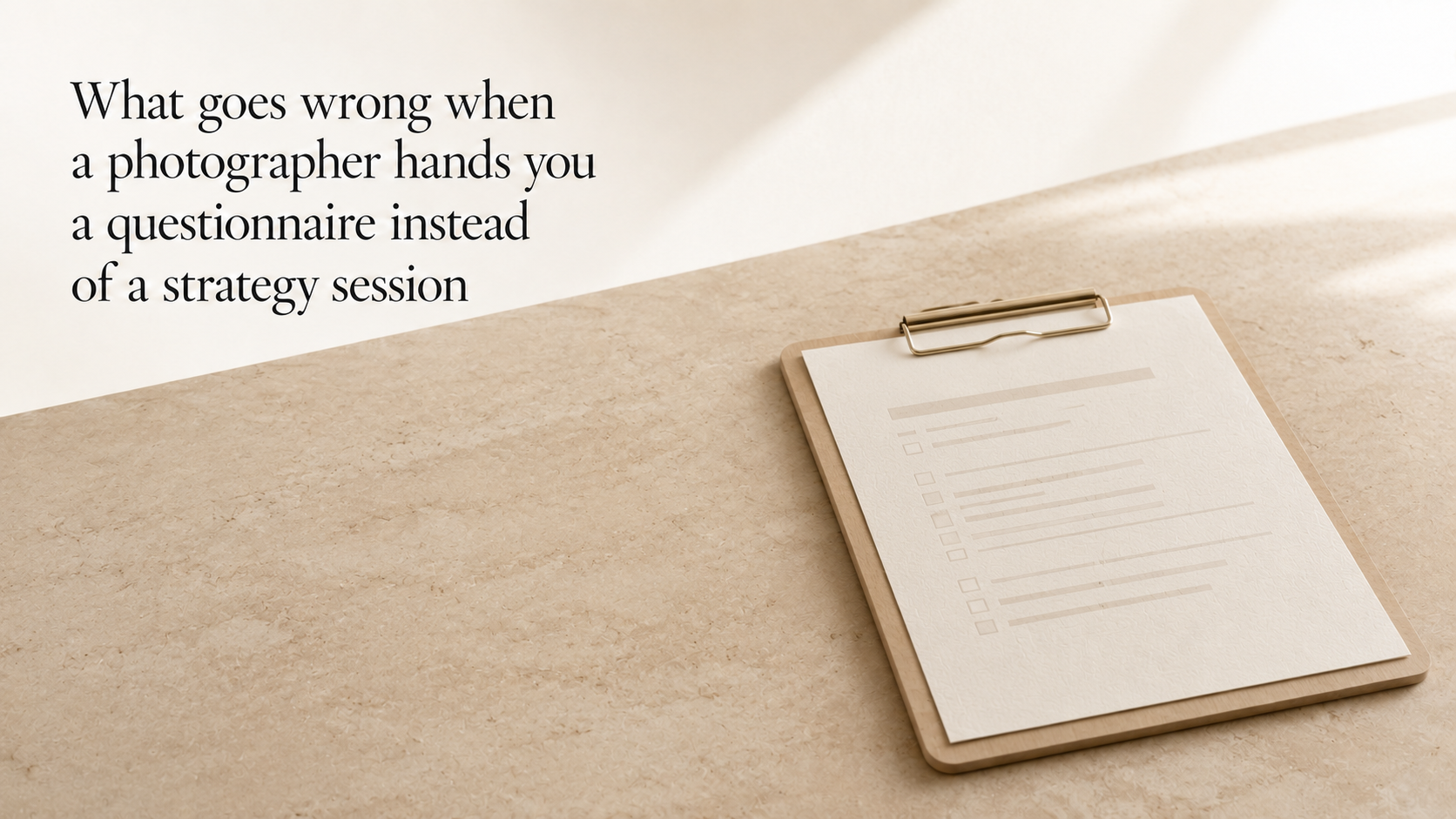
Not a questionnaire sent by email and filled out alone. An in-person or Zoom conversation where you and the photographer map out your ideal client, your brand voice, the image list for every platform, the wardrobe decisions for each context, and the specific shot that goes in each location.
When that work happens first, every decision on the day has a reason. You know which outfit is for the LinkedIn header and which is for the press kit. You know the purpose of the shot before the shutter clicks. The posing prompt makes sense because you understand what the image is for.
Expression coaching during the session handles the rest. A photographer who can read the frame in real time and tell you exactly what to do with your face, your posture, your energy, changes the result of every single photo. “Just relax and be yourself” is not coaching. “Bring your chin down slightly and look two feet to the left of the lens, like you’re thinking through a hard problem for a client” is.
The Three-Phase Session Method (note: brand name A.S.S. Method, restore before publishing)
The preparation framework behind every Gaby Clark Photography session has three phases.
Phase 1: Brand Strategy. Before the camera comes out, you and Gaby work through your ideal client, your brand voice, and the images you need across every platform. The output is a Personal Brand Blueprint, an Ideal Client Blueprint, and a shot list where every image has a job. No homework, no questionnaire, no guesswork. Built together, in the room.
Shine. The session itself, with professional hair and makeup, posing prompts built around your specific use cases, expression coaching in real time, and enough time to shoot everything on the list. No clock running. The session ends when the shot list is done.
Scale. After delivery, the photos go to work. A custom Canva template suite maps every image to its platform: LinkedIn headers, Instagram posts and carousels, Facebook covers, email signatures, webinar slides, letterheads. And the AI Marketing Suite puts eight named experts behind the photos. Leo builds bios. Sonia plans the social calendar. Carter handles content repurposing. Marta writes email campaigns. Megan rewrites website copy. Petra builds the press kit. Luca scripts the VSL. Kane designs the keynote architecture.
The photos are the starting point. The system keeps them working after the gallery is delivered.
The real cost of one more year without new photos
Every month a business runs behind outdated imagery is a month where the visible credibility doesn’t match the actual expertise.
The 2020 headshot. The image that shows someone just starting out, running a business half the size of the one you’re running now. The photo that makes a first-time prospect wonder if they’ve found the right person.
No invoice exists for the clients who didn’t call because the website didn’t match what a referral described. No line item for the press feature that went to someone with a polished press kit. No receipt for the speaking invitation that went to a speaker whose bio photo looked the part.
Those costs are invisible until the math gets run backward.
FAQ
Does personal brand photography only work for people who are comfortable on camera?
The founders who most need this work are often the ones who find it most uncomfortable. The Shine phase, with posing prompts, real-time expression coaching, and professional hair and makeup, is designed specifically for women who find being on camera difficult. Most clients are surprised by how manageable the session feels when the structure is right.
How do I know if I need a headshot or a full brand session?
If you work in a corporate role for a company, a headshot is probably the right choice. If you own your business and you are the face of that brand, a full brand session is almost always the better investment. The consultation call is where that question gets answered for your specific situation.
What if I’ve had a bad experience with a photographer before?
Most bad experiences trace back to one of three things: no strategy before the shoot, no direction during it, or a gallery-and-goodbye handoff at the end. A strategy-first session addresses all three. The difference between a photographer who sends a questionnaire and one who sits with you in person to build the strategy together is the difference between photos you archive and photos you use for years.
How far in advance do I need to book?
Current availability and a booking link for the consultation call are at gabyclark.com.
About the Author: Gaby Clark