Most personal brand galleries die the same quiet way. The photographer sends a download link. The client saves the folder, pulls one image for a new profile picture, and never opens it again. A full shoot day, a real investment, one headshot to show for it.
That folder was built to run a year of marketing. Instead it sits in cloud storage next to old tax returns.
For sixteen years I have watched smart women founders pay for beautiful photos they barely touch. The photos are rarely the problem. The delivery is.
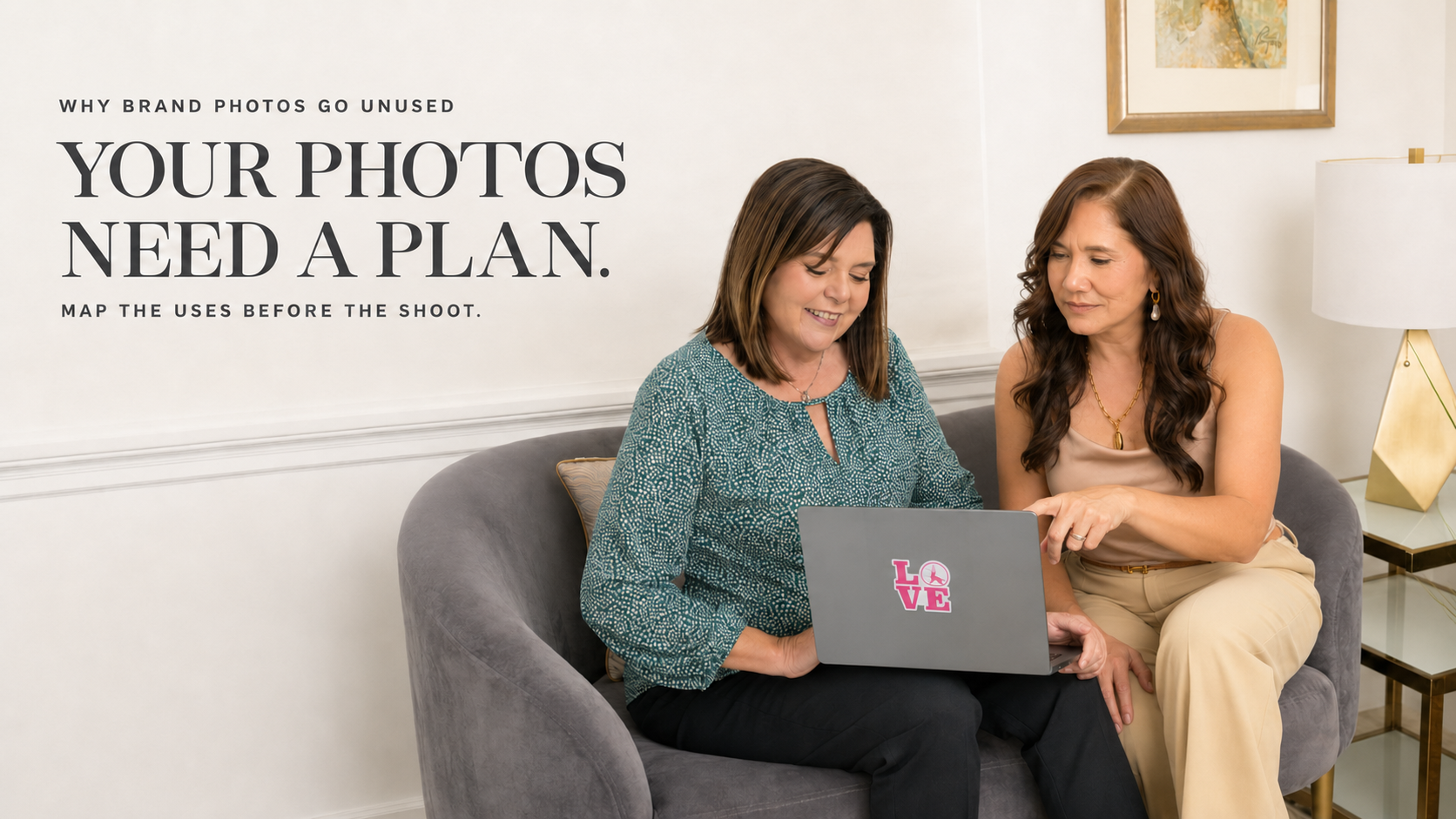
Brand photos go unused because most photographers hand over a folder of files instead of a marketing system. A gallery of pretty images with no plan attached becomes a decision the client keeps postponing. The fix is a session built backward from where every image will live, plus the templates and tools that put the photos to work after delivery.
Why do brand photo galleries end up abandoned?
A gallery gets abandoned when nobody decided, in advance, what each photo was for. Forty images arrive with no labels and no map. Which one anchors the About page? Which three become a carousel? Which belongs on LinkedIn versus Instagram? Choosing feels like homework, so the folder stays closed.
This is the difference between personal brand photography and a stack of headshots. Headshots are one image doing one job. Brand photography is a planned set of images, each with a place to go before the camera comes out.
When the planning never happens, even gorgeous photos have nowhere to land. The gallery is not dead because the work was bad. It is dead because it arrived as raw material with no instructions.
What does a dead gallery actually cost you?
More than the fee. A folder of unused photos costs you the clients who never saw the current version of you.
A visitor forms a first impression of a website in about 50 milliseconds, and roughly 94% of that impression is visual, according to research by Lindgaard and colleagues. A five-year-old headshot on your About page is making that judgment for you, every day, before a word gets read.
Meanwhile the calendar keeps demanding content you do not have images for. The marketing engine stalls at the visual layer, and the whole machine slows down behind it.
How many brand photos does a business actually need?
Fewer than you think, planned better than you would guess. A launch does not need two hundred frames. It needs the right twelve, each mapped to a real place.
Volume is the wrong target. A folder of a hundred near-identical outfit changes is still a dead gallery if none of them was planned for use. Ten images with a job each will outwork a hundred with no plan.
That planning is the ALIGN part of my method. Before the shoot, we get clear on who you serve and where these photos need to work: website, social, PR kit, sales pages, the next six to twelve months of content. Every frame we shoot traces back to one of those.
What keeps a gallery working after the photographer leaves?
A system attached to the images. This is the part almost every photographer skips, and it is the whole reason my clients still use their photos a year later.
My clients leave with the SCALE layer of the Align. Shine. Scale. Method™. That means a Canva template suite already sized for LinkedIn headers, Instagram posts, carousels, Facebook covers, email signatures, webinar slides, and letterheads. Drop a photo in, the graphic is done.
It also means the AI Marketing Suite: eight named experts who draft the work around the images. Leo writes bios. Sonia plans social. Carter repurposes one session into months of posts. Marta writes email campaigns, Megan handles website copy, Petra builds PR kits, Luca scripts VSLs, Kane drafts keynotes. The photos stop being a folder and start being the fuel for a marketing engine.
How do you turn one session into months of content?
You plan the session as a content library, then reuse it on purpose. The data on this is not subtle.
Repurposing existing content increases results by about 75% with no proportional increase in spend, according to Curata. Companies that actively reuse their content see roughly double the engagement of those who rely on new content every time, per HubSpot. And a single long-form asset holds five to ten standalone pieces of social content, by Cloud Present’s count. A planned brand gallery is that asset in visual form.
The gap is execution. In the CMI and MarketingProfs B2B survey, 48% of marketers said their biggest scaling problem was not repurposing enough of what they already own. A gallery is the most reusable asset you will buy all year. Most people let it rot.
How do you plan a session so the photos actually get used?
You start with the ideal client, then work backward to the shot list. That order is the whole game.
In the strategy meeting we name one real person your business serves, not a vague category. Once that person is clear, every photo decision gets easier, because you finally know who each image is talking to. This is the moment most clients realize they had never defined their ideal client at all, only what they do.
From there we map the slots. Website hero, About page, LinkedIn banner, story verticals, sales page, PR kit, the next few months of posts. Each slot becomes a shot we plan for, so nothing gets left to chance on the day.
Wardrobe, location, and posing all trace back to that plan. The result is a gallery where every frame already has a home, which is the opposite of a folder you open once and abandon.
No questionnaire does this. It gets built in the room, together, because that is the only way it actually gets done.
FAQ
How long do personal brand photos last before you need new ones?
A well planned brand shoot carries a business twelve to eighteen months, sometimes longer. What ages a gallery is not the photos, it is a change in the business the photos were built for. A new offer, a pivot, or a rebrand is the real signal to shoot again, not the calendar.
Why do you not use the brand photos you already paid for?
The usual reason is that the gallery arrived as a folder of files with no plan attached. Nobody told you which image goes on LinkedIn, which one anchors the About page, which three become a carousel. Without that map, choosing feels like work, so the folder stays closed.
Do you need a brand strategy or just good photographs?
You need both, and the strategy comes first. Good photos of the wrong things, planned for nobody in particular, still go unused. The strategy names your ideal client and the exact places each image will live, so every frame has a job before the camera comes out.
What is the difference between a photo gallery and a marketing system?
A gallery is a set of images. A marketing system is those images plus the templates and tools that put them to work: sized graphics for every platform, and AI experts that draft the bios, captions, and emails around them. One sits in storage. The other runs your marketing for months.
Ready for a gallery you will actually use?
A brand session should end with a working marketing engine, not a folder you feel guilty about. Book a call at gabyclark.com and we will plan photos with a job to do, then hand you the tools that keep them working long after the shoot.
About the Author: Gaby Clark