Somewhere in your inbox is a PDF full of questions about your brand. It arrived weeks before your session with a friendly note asking you to fill it out whenever you get a chance. You opened it once, got to question four, “What three words describe your brand?”, and closed the tab.
That PDF was the brand strategy. The whole thing.
Nobody says that part out loud. But when a photographer’s process begins and ends with a form you complete alone, the strategy layer of your session is whatever you managed to type at 11pm between client calls. For most women running a real business, that means nothing at all.
A questionnaire asks you to arrive at brand clarity alone, which is the one thing most business owners cannot do alone. A strategy session builds it with you in the room. The result is a shoot planned around a real client and a real message, instead of a shoot planned around your outfit changes.
Why do photographers send questionnaires in the first place?
Because a form is cheap and a meeting is not.
A questionnaire gets built once and costs nothing after that. A strategy session costs real hours per client, every client, plus the skill to run one. The math favors the form.
There is a second reason, less flattering. Most photographers do not know how to run the meeting. Brand strategy is a different discipline from lighting and posing, and nothing in a photography education teaches it. A form lets a photographer offer the appearance of strategy without the ability to deliver it. You fill in the blanks. The photographer prints the answers. The session gets called “strategy-first” on the pricing page and everyone moves on.
The form also protects the photographer from a conversation that could go badly. If you cannot describe your ideal client, that becomes your problem on a PDF. In a room, it becomes the photographer’s problem to solve, and solving it takes actual expertise.
Do people actually fill out client questionnaires?
Mostly not, and the numbers are worse than you would guess.
Across companies tracking their own customer onboarding checklists, the average completion rate is 19.2%, with a median of 10.1% (Userpilot, 2025 Onboarding Checklist Completion Rate Benchmark Report). That is a checklist inside software people already paid for and already logged into. A brand questionnaire from a vendor you have met once faces a steeper hill than that.
General form research explains the drop-off. Length drives 27% of form abandonment, and unnecessary questions account for another 10% (Formstory, Form Abandonment Statistics). A brand questionnaire is both at once: long, and full of questions that read as unnecessary because the person answering cannot see what any of them are for.
So the honest version of the standard photography process reads like this. Most clients never complete the form. Of the ones who do, most answer quickly to be polite. And the photographer builds a shoot on top of it either way, because the shoot date is already on the calendar.
What goes wrong when the questionnaire comes back?
Four things, in roughly this order.
You describe what you do, not who it is for. Almost every business owner filling out a brand form describes the service. Nutrition coaching for busy professionals. Financial planning for families in transition. Both true. Neither one names a human being. A photo plan built on a service description is a photo plan aimed at nobody in particular, which is how you end up with images that could belong to any consultant in the Bay Area.
The three-word brand exercise returns the same three words every time. Approachable. Professional. Authentic. Some version of those comes back on nearly every form. Words that describe most competent businesses describe your business no differently, and a mood board assembled from them looks like every other mood board on Pinterest.
Nobody asks you the second question. The most useful moment in a real strategy meeting is the follow-up. You say your client is “women in transition,” and someone asks: which transition, at what age, earning what, choosing between you and which two other options. The real answer lives in that follow-up. A PDF cannot ask it, cannot hear you hesitate, and cannot notice that you just changed your answer halfway through the sentence.
The gap stays invisible until the gallery lands. Photos get taken. Photos get delivered. Then they sit in a folder while you try to work out which one goes on the About page and which one goes on LinkedIn, and whether any of them fit the sales page you are writing next month. The plan was never made, so there is nothing to execute against. You are doing the strategy work after the shoot, alone, with a fixed set of images that were not planned for it.
That last one is the expensive failure. Everything before it is recoverable. A gallery built without a plan is money already spent.
What does an in-person strategy session actually do?
It builds the two documents the form was hoping you would write yourself: your ideal client and your brand voice. Together, out loud, in one sitting, with someone whose job is to keep asking until the answers get specific.
At Gaby Clark Photography that meeting happens before any camera comes out, in person or over Zoom. We define the ideal client. We define the brand voice. We map the photos across your website, social channels, PR kit, and sales pages, then plan wardrobe and locations against that map. You arrive on shoot day already knowing what every single setup is for and where the image is going to live.
The turning point in that meeting is almost always the same, and it has nothing to do with photography. It is the moment a business owner realizes the ideal client was never actually defined. Everyone believes they have done it. Very few have. Once the gap between “I help women in transition” and one specific, real person is sitting there on the table, every photo decision after that lands differently, because you finally know who you are talking to.
This is the ALIGN phase of the Align. Shine. Scale. Method™, and it exists first for a reason. Wardrobe decisions depend on it. Location decisions depend on it. The shot list depends on it. Skip it and the rest of the session is guesswork with good lighting.
How do you tell a real strategy session from a questionnaire with a nicer name?
Ask four questions on the consult call. The answers separate the two immediately.
- Who fills this out? If the answer is “you, and email it back to me,” you are looking at a form regardless of what the website calls it.
- How long is the meeting and where does it happen? Real strategy takes a working session, live, before a shoot date gets set. A quick call to “go over your answers” is a review of a form, not a build.
- What do I walk out with? A named ideal client and a defined brand voice, written down and yours to keep. If the only deliverable is a mood board, the strategy stopped at aesthetics.
- What happens if I do not know the answers? The right response is that the photographer expects that, and the meeting exists precisely because you do not. Anyone who needs you to arrive with clarity already built is asking you to do their job for them.
A fifth signal, harder to ask about directly: whether the photographer has ever run a brand strategy meeting for anyone. Look for the language on their site. “Tell us about your brand” is a form. “We define your ideal client together” is a meeting.
What does the difference cost you after the shoot?
Mostly it costs you the money you already spent.
Consistent brand presentation across channels is associated with revenue gains of roughly 10% to 33%, depending on the study, with the widely cited Lucidpress research (now Marq) landing at the top of that range. Consistency requires a defined message underneath it. Photos taken without one cannot produce it, no matter how good the light was that day.
Then there is the marketing tax. 72% of small business owners report feeling overwhelmed by marketing decisions (LocaliQ, small business marketing statistics). An unplanned gallery makes that number personal: more files, more decisions, and no framework for choosing between them. Which is exactly how an expensive session ends up as the same three images on repeat.
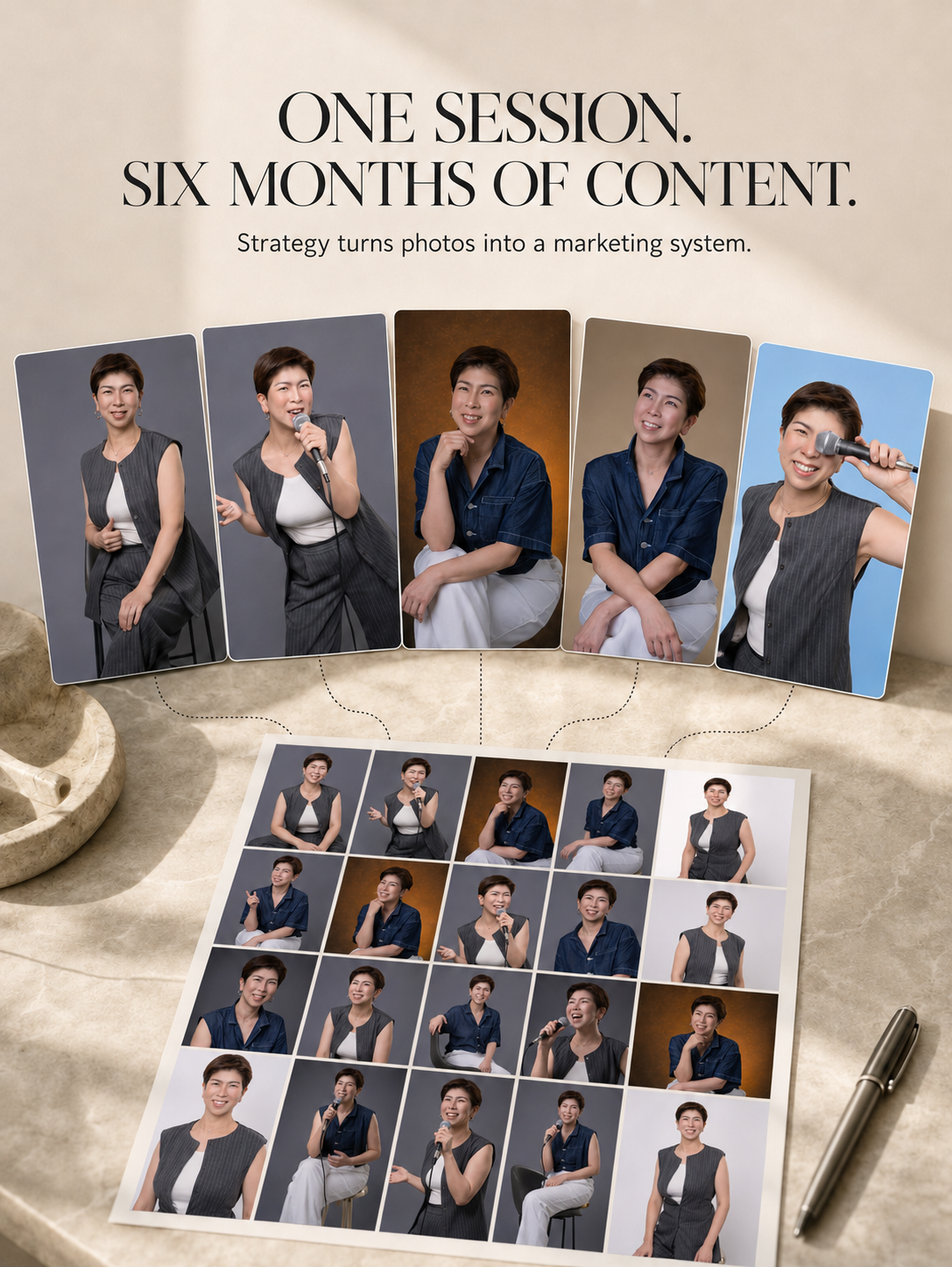
The plan is what makes the photos usable. With one, the session produces a year of content you can actually deploy: a Canva template suite covering LinkedIn headers, Instagram posts, carousels, covers, Facebook covers, and email signatures, plus the AI Marketing Suite of eight named experts (Leo for bios, Sonia for social planning, Carter for repurposing, Marta for email campaigns, Megan for website copy, Petra for PR and media kits, Luca for VSL scripts, Kane for keynotes) that all write from the brand you defined in that first meeting.
Every one of those tools reads from the ICA and the voice. Which is why the meeting comes first, and why a form cannot stand in for it. Feed a vague answer into the top of that system and vague copy comes out the other end, faster than before.
FAQ
Is a brand photography questionnaire ever useful?
Yes, for logistics. Address, parking, hair and makeup preferences, wardrobe sizes, arrival time: a form handles all of that well and saves everyone a phone call. The failure happens when a form is asked to do strategy. Questions about your ideal client and brand voice need a conversation, because the useful answers only surface after someone asks a follow-up you were not expecting.
What if I already know my ideal client?
Most business owners believe that, and the strategy session usually proves the definition is one layer too broad. “Women in transition” is a category, not a person. Your actual client has an age, an income, a decision currently on the table, and two competitors under consideration instead of you. Photographing a category produces generic images. Photographing a person produces images with a job.
How long does a brand strategy session take?
Plan on a full working session, in person or over Zoom, before any shoot date gets set. You leave with a Personal Brand Blueprint, an Ideal Client Blueprint, and a photo plan mapped to your website, social channels, and PR needs. There is no homework beforehand and no form to complete alone. The work happens in the room, together.
Do I need brand strategy if I only want headshots?
If you work in a corporate office, headshots are genuinely what you need, and a strategy session would be overkill. If you own the business and your face is the brand, headshots solve a small piece of the problem. Your website, sales pages, and content calendar all need images of the work itself, not five versions of your face against a grey wall.
Can I do the brand strategy work myself before booking?
You can try, and a few people manage it. The obstacle is not intelligence, it is proximity. You cannot see your own business from the outside, which is the exact vantage point the ideal client work requires. Most women who arrive having done the homework alone still find the definition moves significantly once someone outside the business starts asking questions.
The takeaway
A form cannot ask you the second question. That is the entire difference, and it explains why a questionnaire produces a folder of photographs while a strategy session produces a brand you can market with for the next year.
If your last session ended with a gallery you barely used, the missing piece was upstream of the camera. It was never about the photographer’s lighting.
Book a consultation. That call covers what brand photography means for your specific business, and whether a strategy-first session is the right fit before anyone talks about dates.
About the Author: Gaby Clark