The gallery arrives on a Tuesday. Sixty retouched images, exactly what was ordered. By Friday, four are on Instagram, one is on LinkedIn, and the website still runs the photo from 2021.
That ending has almost nothing to do with the photos.
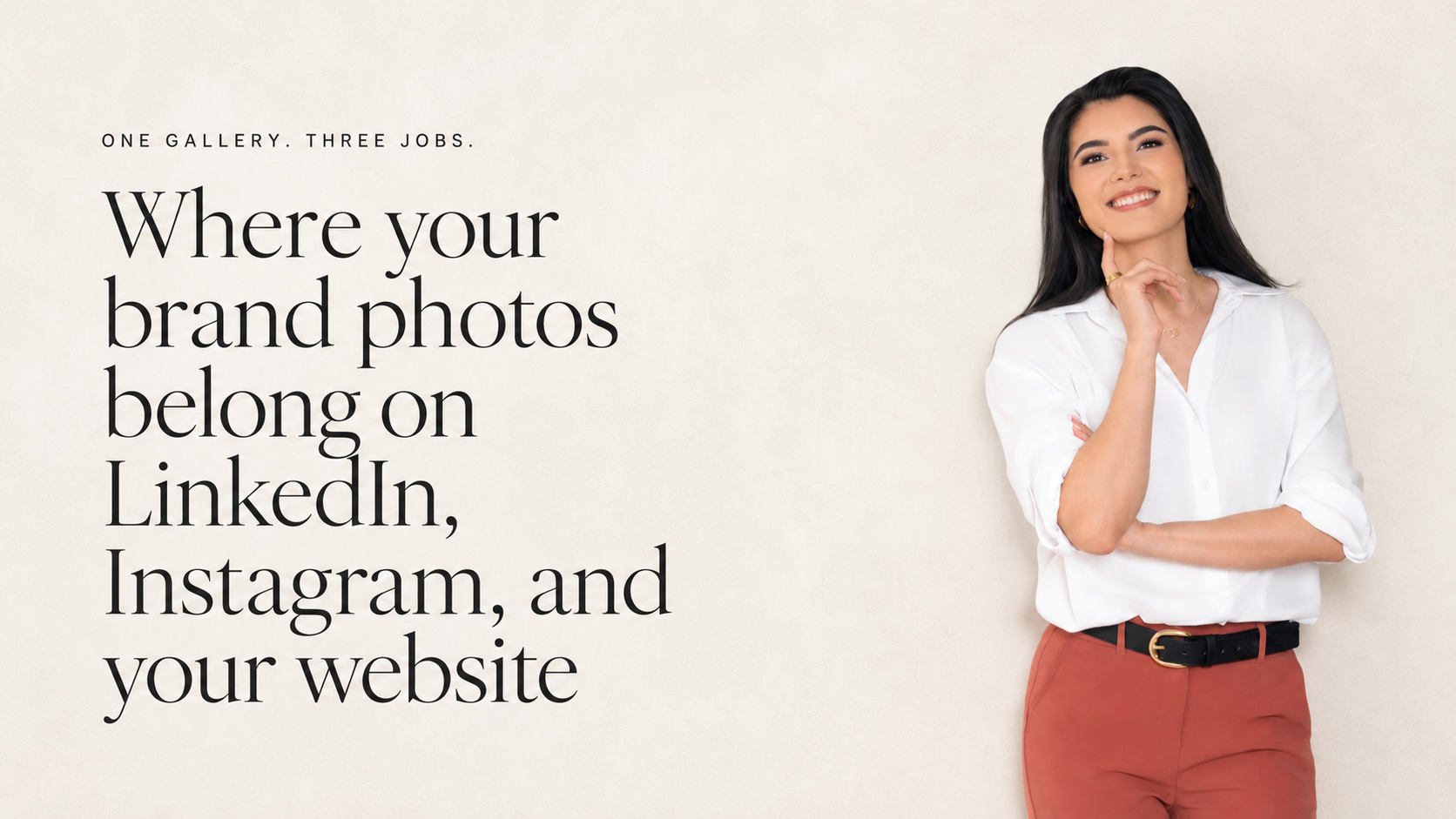
Three placements, three different jobs. LinkedIn needs a face that reads at fingernail size. Instagram needs vertical frames and enough of them to keep a swipe going. A website needs room around the subject so a headline has somewhere to sit.
One image rarely does all three, and nobody says that out loud at the shoot.
The short answer
Use tight, eye-contact frames on LinkedIn, where the photo has to carry credibility at thumbnail size. Use working shots and sequences on Instagram, where movement and context earn the swipe. Use wide, negative-space frames on your website, where the image has to hold text and set the tone before anyone reads a word.
Why does the same photo work in one place and fail in another?
Because each platform crops differently, sizes differently, and asks the viewer for something different.
LinkedIn renders a profile photo as a small circle. Detail disappears. At that scale, three things survive: the face, the eyes, and the contrast between the subject and the background.
Instagram gives you a 4:5 vertical in the feed and a 9:16 full screen in Stories and Reels. Horizontal frames lose their edges in both.
A website header runs wide, sometimes close to 3:1, with text laid over the top. A tight portrait cropped to that ratio becomes a band of forehead.
A photographer who plans for all three shoots them separately. A photographer who does not hands over sixty frames from the same distance and lets the client find out in March.
How should you use brand photos on LinkedIn?
Tight, direct, and in sets. LinkedIn rewards a face you can identify at a glance and a feed that keeps producing images.
The profile photo carries the most weight on the platform. Figures compiled through 2026 report that profiles with a professional photo receive roughly 21 times more views and 36 times more messages than profiles without one. Treat that number as directional; it circulates widely without a current primary study behind it. The direction has never been in dispute.
The feed matters more than most people assume. Socialinsider’s 2026 LinkedIn benchmarks put image posts at a 5.20 percent average engagement rate against 3.95 percent for text-only posts in Q2 2026. Vulse’s 2026 format breakdown ranks native document posts highest at 7.00 percent, followed by multi-image posts at 6.45 percent.
Placement, in order of what it costs you to get wrong:
- Profile photo. Head and shoulders, eyes to camera, clean separation from the background. Test it at 100 pixels wide before committing.
- Banner. A wide environmental frame with empty space on one side. Your face does not belong in it, because the profile photo already sits on top.
- Featured section. One working shot per offer. A photo of you mid-consultation says more about the service than a portrait does.
- Feed posts. Multi-image posts and documents outperform singles. Plan for sets.
How should you use brand photos on Instagram?
In sequences. Instagram pays for the second, third, and fourth frame.
Socialinsider’s Q2 2026 Instagram benchmarks put carousels at a 0.50 percent engagement rate against 0.33 percent for static images, and multiple 2026 analyses put carousels at roughly 114 percent more engagement than single-image posts. A carousel earns a pause. A single photo earns a thumb.
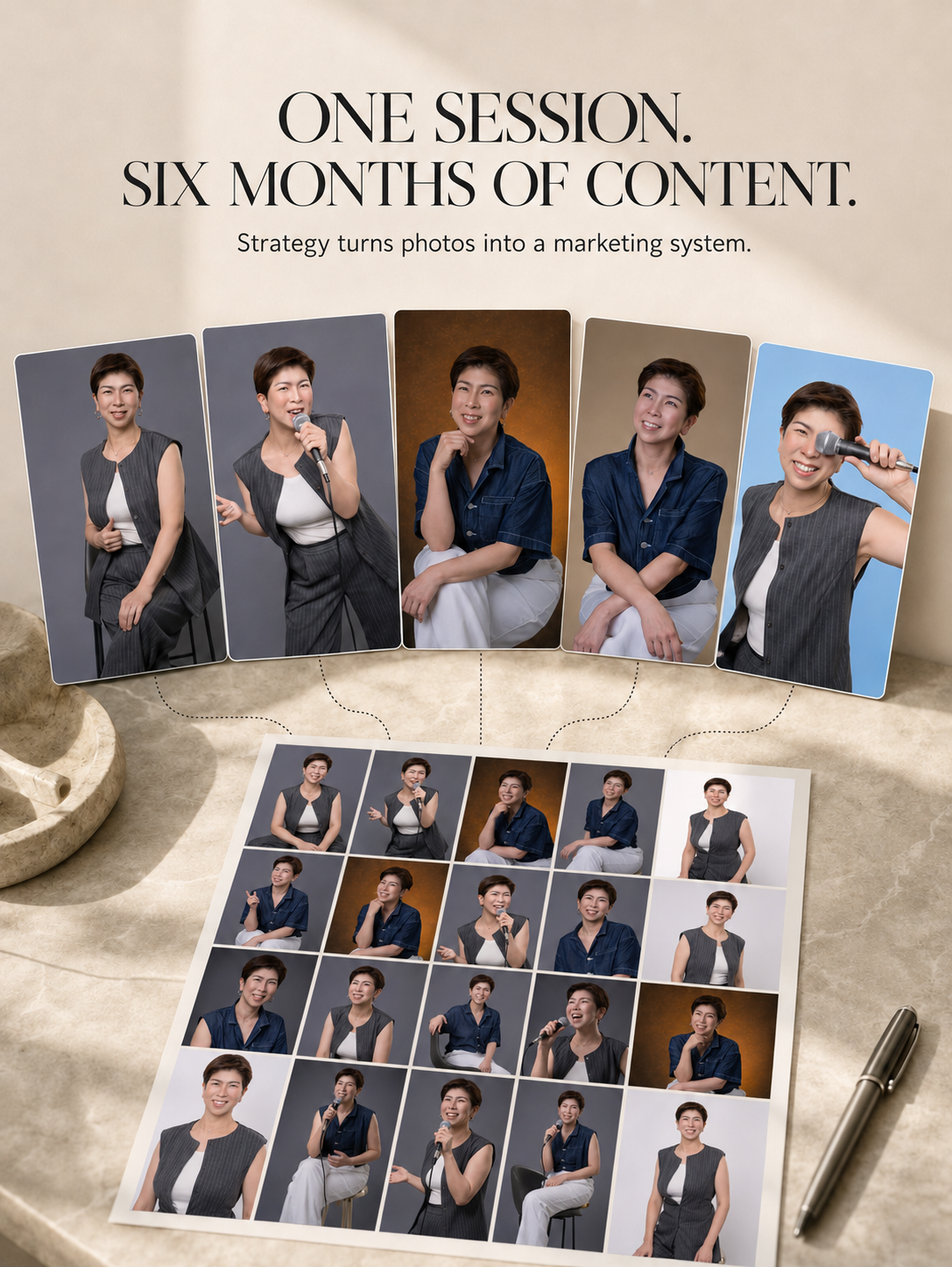
That changes what a session has to produce. Ten strong singles give you ten posts. Ten sequences of five give you fifty frames that belong together, plus covers, plus filler for Stories.
- Grid. Vertical 4:5. Mix face frames with working frames so the grid reads as a business and not a portfolio of one person.
- Carousels. Frames from the same scene, in order. Same outfit, same light, small changes in position.
- Stories and Reels covers. 9:16 with clear space at the top and bottom, because the interface eats both.
- Pinned posts. Three pinned posts are a second homepage. Pick one photo per offer.
Where do brand photos belong on your website?
Above the fold, on the About page, and beside every offer. Those three carry the most weight and each needs a different frame.
The Stanford Web Credibility Project found that 46.1 percent of people judge a site’s credibility on visual design, which puts image quality ahead of most of the copy anyone agonized over. VWO’s testing archive includes cases where replacing generic icons with photographs of real people lifted conversion by as much as 48 percent.
- Header. Wide, subject off-center, empty space where the headline goes. Ask for these at the shoot. They cannot be cropped into existence afterward.
- About page. The one frame that looks like a real day at work. Your future client is deciding whether working with you feels comfortable.
- Service pages. One photo per offer, showing the work itself.
- Contact page. A warm, open frame. It is the last thing someone sees before deciding whether to fill out the form.
The three-jobs test
Before the shoot, take every planned scene and ask which three places it feeds.
A scene with no answer gets cut. A scene with three answers gets shot from three distances: wide for the website, medium for the carousel, tight for the profile.
That is the difference between sixty images and a working library. Sixty images is a number. A library has assignments.
What to ask before you book
Six questions, asked on the consultation call:
- How many vertical frames, and at what ratios.
- How many frames have negative space for text.
- Are there wide environmental frames for a website header and a LinkedIn banner.
- Are we shooting sequences from the same scene, so carousels are possible.
- Are we photographing the work, or only the face.
- How do the files arrive, sorted by destination or sorted by favorite.
A photographer who has thought about where the photos go answers each one in a sentence. One who has not will tell you the gallery is going to be beautiful.
Frequently asked questions
How many brand photos do you actually need for a year of content?
Between 40 and 60 images with defined jobs will carry a solo business for a year. The number matters less than the spread: tight, medium, and wide versions of each scene, both orientations, and at least a third with room for text. Sixty frames at the same distance run out in six weeks.
Can one photo work on LinkedIn, Instagram, and a website?
One scene can. One frame usually cannot. LinkedIn wants a square that survives a small circle, Instagram wants 4:5 vertical, a website header wants wide with space for a headline. Cropping a tight portrait into a wide banner throws away resolution and composition at once. Shoot the scene at three distances instead.
How often should you update your brand photos?
Every 18 to 24 months for most service businesses, and immediately after any real change: a new offer, a rebrand, a pivot, a different price point. The trigger is the gap between what the photos say and what the business now sells, and that gap can open in a single quarter.
What is the biggest mistake people make with a new gallery?
Posting the favorites first. The images that feel best are usually the tightest portraits, which are the least useful frames in the set. Start by assigning the wide and medium frames to the website, the banner, and the carousels. Save the close portraits for the profile photo and the moments that call for a face.
Assign the frames before you post any of them
A gallery becomes a marketing library the moment every frame has an address. That decision gets made in the strategy meeting, before anyone picks up a camera.
If your photos are sitting in a folder and your website still runs the 2021 headshot, book a consultation at gabyclark.com and we will map where every frame goes.
About the Author: Gaby Clark