Most women plan wardrobe the night before the shoot. The gallery gets built, the strategy gets set, the location gets scouted, and then, at 10pm, the closet gets raided in a panic. The outfit is the one decision that shows up in every single frame, and it tends to get the least thought.
That order is backwards. Clothing is not the last detail of a brand session. It is one of the first things a stranger reads about you, and the research on that is almost uncomfortable.
What does it mean for clothing to “photograph well”?
Clothing photographs well when it stays out of the way of your face and reads clean at every crop, from a website banner to a phone-sized square.
A camera sensor sees fabric differently than your bathroom mirror does. Tight stripes and small checks fight the sensor and produce a shimmering moiré pattern that no retouching fully removes. Shiny fabrics catch light and blow out. Brand-new clothes that still hold the fold lines photograph stiff. What looks fine standing still can wreck a frame once it is lit and shot at high resolution.
The clothes that photograph well share a few plain traits: solid colors, real fit, matte fabric, and a bit of texture instead of busy pattern. Nothing about that is glamorous. It works because it lets the camera do its actual job, which is showing your face and your presence, not your shirt.
Why do your clothes change how competent you look?
Your clothes change how competent you look because viewers read status and competence off clothing in a fraction of a second, before conscious thought catches up.
A 2020 study out of Princeton, published in Nature Human Behaviour, put the same face in different upper-body clothing. When the clothing read as “richer,” viewers rated the face significantly more competent. When it read as “poorer,” the competence score dropped. The unsettling part: the effect held even when people saw the image for only 129 milliseconds, and even when they were warned the clothing meant nothing and told to ignore it. They could not ignore it (Oh, Shafir & Todorov, Nature Human Behaviour, 2020).
That sits on top of an older finding from the same lab’s field. Viewers form judgments of trustworthiness, likeability, and competence after just 100 milliseconds of seeing a face, and giving them more time to look does not move those judgments (Willis & Todorov, Psychological Science, 2006).
Put those together and the takeaway is blunt. A prospect on your About page decides whether you look like the expert in the time it takes to blink, and your wardrobe is casting a vote in that decision whether you planned it or not.
What should you actually wear for brand photos?
Wear solid colors in a hue that suits your coloring, in clothes that fit you now, in matte fabric with some texture.
Fit comes first. A well-fitted piece in a plain color will always outperform an expensive piece that pulls or bags. If a jacket gapes at the button or a sleeve swallows your wrist, the camera finds it. Get the fit right before you worry about anything else.
Color is the second lever, and it does more work than people expect. Color raises brand recognition by up to 80% compared with monochrome, per a University of Loyola study widely cited in marketing work. For a personal brand that means your wardrobe is a chance to reinforce the colors that already run through your website and content, so the photos and the brand read as one thing instead of two. Deep neutrals, navy, charcoal, and controlled jewel tones tend to photograph with authority. Pale pastels and stark white can wash out against studio light, especially on fair skin.
Texture is the third. A ribbed knit, a soft blazer, a linen weave adds visual interest without the moiré risk of a hard pattern. It gives the image somewhere to breathe.
What should you skip?
Skip loud patterns, shiny fabric, brand-new stiff clothing, and anything you bought for the shoot that does not feel like you.
Tight stripes and small checks are the classic technical failure, the moiré risk. Sequins and satin bounce light in ways that fight the lighting setup. A blazer straight off the hanger with fold creases photographs as a rumpled blazer. And the outfit you bought specifically to look “professional,” the one that is a size and a personality away from your real wardrobe, tends to read as a costume. The camera is very good at spotting borrowed confidence.
One more to skip: dressing for who you were three years ago. Founders evolve. If your business has grown into something more serious and your closet has not caught up, the photos will preserve the gap.
How many outfits do you need, and how do you plan them?
Plan one outfit per job the photos have to do, not one outfit per hour of shooting.
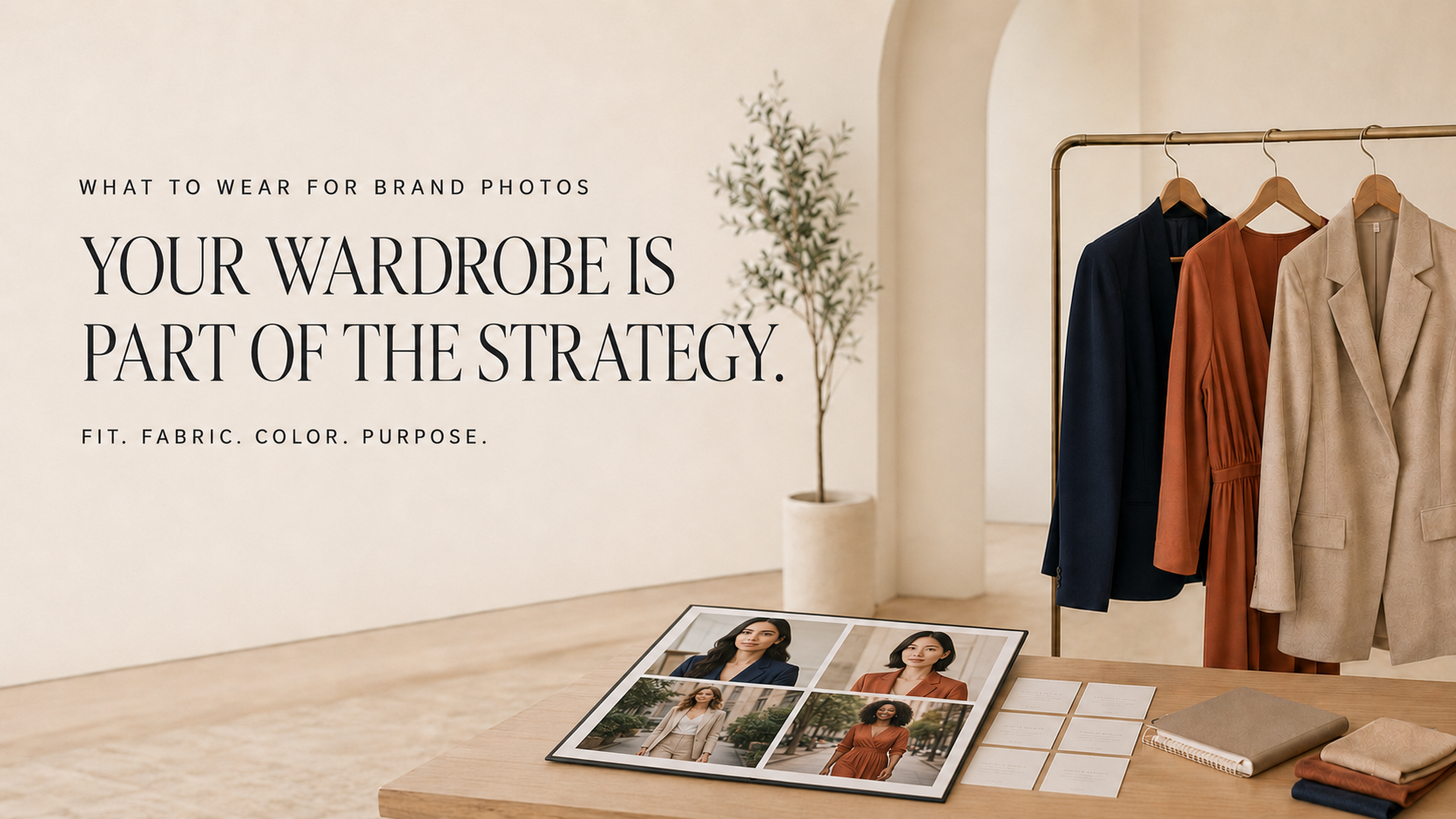
This is where wardrobe stops being a shopping question and becomes a strategy question. A brand session is not one look repeated. It is a planned set of images for specific uses: a polished portrait for the website and press, a warmer approachable look for social, a working outfit for the shots of you actually doing the work. Map the outfits to the shot list, and the number answers itself. Three to five looks covers most brand sessions, each earning its place.
In my process, wardrobe gets planned in the strategy session, not left to the client alone the night before. We look at the shot list, the locations, the colors already in the brand, and we build the outfit plan together, so nobody is standing in front of a closet at 10pm guessing. That is the difference between a session that fills a content calendar and one that produces three usable frames.
Why wardrobe is really a strategy decision
Wardrobe gets easy the moment you know who the photos are talking to, and impossible when you do not.
A health coach called me once wanting two headshots for a new website. On the phone we talked through what brand photography actually is, photos of her with clients, working out, eating well, the full arc of her work. By the strategy meeting a bigger gap surfaced. The ideal client had never been defined at all. The thinking had always been about what the work was, never about who it was for.
Once we built that ideal client together, every decision after it settled, including wardrobe. When you know exactly who you are dressing to reach, “what do I wear” stops being a style riddle and becomes an obvious answer. The outfit follows the strategy, the same way the location and the shot list do.
That is why I do not book anyone without a consultation first, and why the wardrobe plan lives inside the Align. Shine. Scale. Method™ rather than in a last-minute text. Clothing is doing measurable work on how competent you read. A decision that important should not happen in a panic.
FAQ
What colors should I wear for personal brand photos?
Wear solid, deeper hues that suit your coloring and reinforce your brand colors, navy, charcoal, controlled jewel tones, and considered neutrals. Color raises brand recognition by up to 80% compared with monochrome, so a wardrobe that echoes your website palette makes your photos and your brand read as one. Avoid pale pastels and stark white, which can wash out under studio light.
What should I not wear for a brand photography session?
Avoid tight stripes and small checks, which clash with camera sensors and create a moiré shimmer. Skip shiny fabrics that bounce light, brand-new clothing with fold creases, and any “professional” outfit that does not feel like you and reads as a costume. Busy patterns pull attention off your face, which is the one thing the photo needs to carry.
How many outfits do I need for a brand shoot?
Plan one outfit per job the images must do, usually three to five looks: a polished portrait for website and press, a warmer look for social, and a working outfit for shots of you doing the work. Map outfits to the shot list rather than to the clock, so every look earns a place in your content.
Does what I wear really affect how professional I look in photos?
Yes, and faster than you would think. A Princeton study found the same face is rated significantly more competent in clothes that read as richer, and the effect held at 129 milliseconds of exposure even when viewers were told to ignore the clothing. Since people judge competence from a face in about 100 milliseconds, your wardrobe is shaping that verdict before anyone reads a word.
The bottom line
Wardrobe is not the last thing you handle before a brand shoot. It is one of the first things a stranger reads about you, and the research says clothing moves how competent you look in the time it takes to blink. Plan solids over loud patterns, fit over labels, and one outfit per job the photos must do. Best of all, plan it against a strategy, so the clothes reinforce who you are becoming instead of preserving who you were.
If you are the face of your brand and the closet-panic-at-10pm plan sounds familiar, book a consultation at gabyclark.com. We plan wardrobe inside the strategy, against your real shot list, so every outfit works as hard as you do.
About the Author: Gaby Clark