Most women book a first brand photography session the way they’d book a haircut. Find someone with a pretty portfolio, ask for a couple of headshots, pick a date. Six weeks later a gallery of nice-looking photos lands in the inbox. Within a month, most of them sit untouched in a folder. The photos aren’t the problem. The booking was.
Brand photography is one of the few investments where the miss happens before the camera comes out. Get the booking right and every image has a job to do for the next year. Get it wrong and you’ve paid professional rates for expensive profile pictures.
The biggest mistake women make booking brand photography for the first time is choosing on aesthetics and asking for a couple of headshots before anyone has defined who the photos are for. That skips the strategy layer, so the images look polished and sell nothing. Building the strategy first is what prevents it.
What is the biggest mistake first-time brand photography clients make?
The mistake is buying images instead of buying a strategy.
A first-time client almost always opens with the same line: “I think I just need a couple of headshots.” For a corporate employee who needs a clean photo for a company directory, that’s the right request. For a woman who is the face of her own business, it’s the start of an expensive miss. The business runs through her face, her voice, her point of view. A headshot captures none of that.
When the booking gets framed as “a couple of headshots,” the whole session gets scoped as a commodity. Same person, a few outfit changes, a neutral background, done. The result is a set of portraits with no plan behind them, which is exactly why they end up unused. Photos without a strategy have nowhere to go.
Why does booking on portfolio aesthetics backfire?
A beautiful portfolio proves one thing: the photographer can make a flattering picture. It says nothing about whether they can tell you who your photos should be talking to.
That gap matters more than most first-timers expect. People form an impression of a face in about 100 milliseconds, and those snap judgments correlate above 0.90 with the opinions they’d reach given all the time in the world (Willis and Todorov, Princeton). Of every trait measured, trustworthiness registers fastest. A photo that is technically gorgeous but aimed at no one still has to survive that tenth of a second, and a generic image rarely does.
Choosing a photographer purely on feed aesthetics bets on the wrong thing. The real question is whether the images will do a job for a specific person you are trying to reach, not whether they photograph well.
Isn’t a questionnaire enough to cover the strategy?
No, and this is where the second mistake hides. A photographer who emails a branding questionnaire and calls it strategy has handed the hardest part of the work back to the client.
Nobody fills those out properly. The few who do usually don’t know what to do with their own answers, because defining an ideal client and a brand voice is a thinking exercise that needs a guide, not a form to fill in alone. The strategy has to be built with the client, in the room, or it doesn’t get built at all.
The moment that proves it is the one first-timers never see coming: the realization, mid-strategy, that they had never actually defined who their photos were for. They knew what they did. They had never pinned down who it was for. Every photo decision lands differently once that gap closes.
What actually gets skipped when you rush the booking?
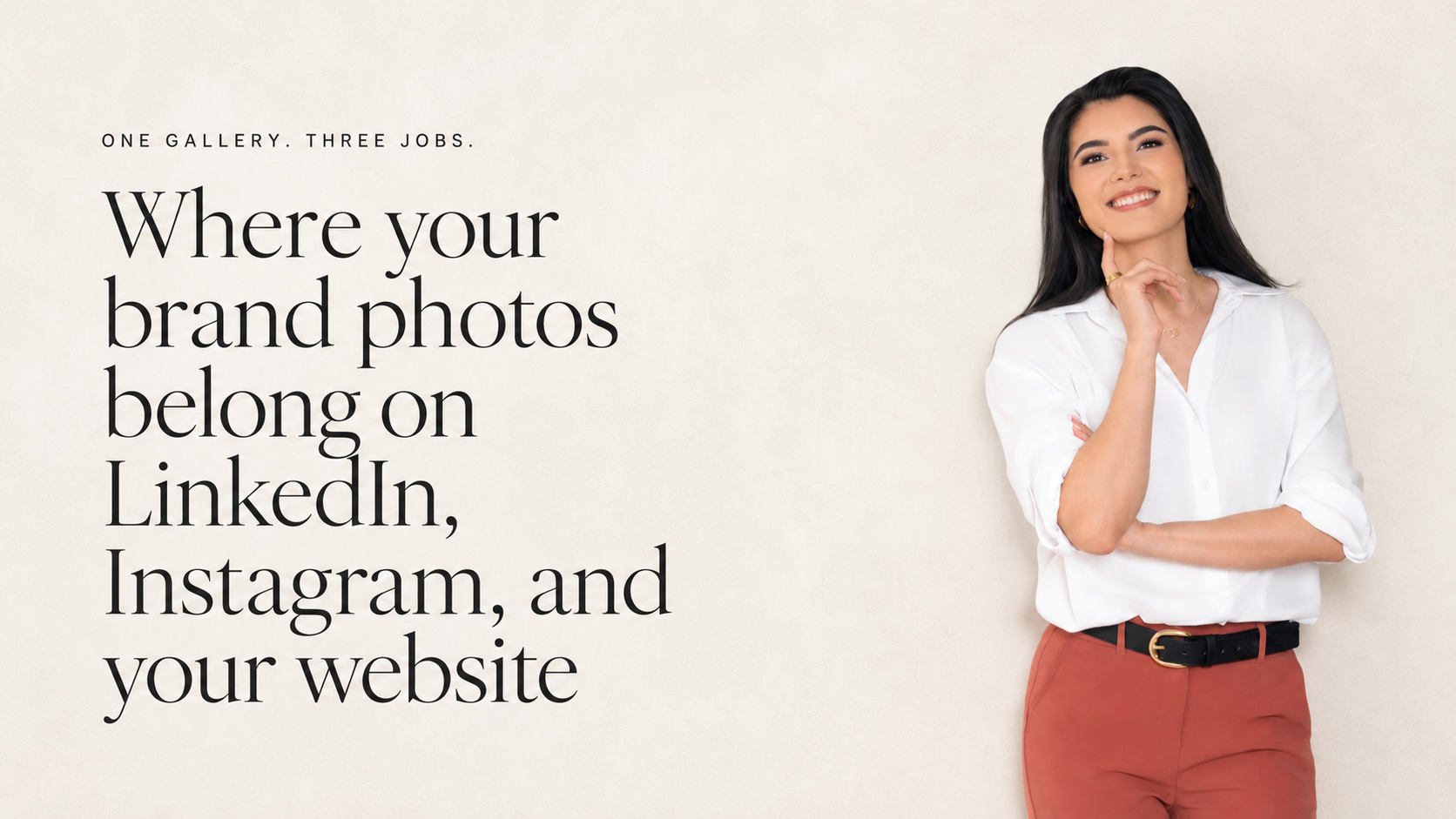
The use-case map. A brand session should be planned around where the images will live: the website, social feeds, a PR and media kit, sales pages, and the next six to twelve months of content.
Skipping that map is costly, because the visuals carry more weight than they seem to. Roughly 75% of consumers judge a company’s credibility by its website design (Stanford Web Credibility Research), and visitors spend an average of about six seconds on a site’s main image before they read a word of copy. On LinkedIn, profiles with a strong photo pull up to 21 times more views and 9 times more connection requests. Photos are the first sales conversation your future client has with your business, and that conversation happens whether or not you planned for it.
A rushed booking produces images for none of those places in particular, which is how a full gallery still leaves a founder with “nothing to post.” The bottleneck was a set of photos built without a destination, not a lack of effort.
How do you book brand photography the right way the first time?
Start with the strategy, not the calendar. The right first step is a conversation about the business, not a date and a deposit.
That is the spine of the Align. Shine. Scale. Method™. ALIGN comes first: an in-person strategy meeting to define the ideal client and the brand voice before any wardrobe or location gets chosen. No homework, no questionnaire to wrestle with alone. SHINE is the session itself, planned shot by shot around the strategy, with wardrobe guidance, locations that say something about the business, posing prompts, and professional hair and makeup. SCALE is what keeps the photos working after delivery: a Canva template suite plus an AI marketing suite of eight named experts that handle bios, social planning, content repurposing, email, website copy, PR kits, video scripts, and keynotes.
A health coach booked exactly this way. The call started with a request for two headshots for a new website. Walking through what brand photography actually is, photos with clients, working out, eating well, the full arc of the work, changed the plan. By the strategy meeting, the coach realized the ideal client had never been defined at all. Every image from the shoot then had a purpose across website, blog, and social, and the marketing suite meant those images kept earning long after the gallery arrived.
That is the difference a right booking makes. The photos become a working part of the business instead of a folder nobody opens.
FAQ
How is brand photography different from headshots?
A headshot is a single flattering portrait, usually for a directory or a badge. Brand photography documents the full arc of a business: the founder working, meeting clients, and in the spaces where the business actually lives. Headshots are a subset for corporate use. Brand photography is a visual system built for marketing.
How much planning should happen before I book the session?
The planning is the booking. Before a date gets set, a strategy-first photographer defines your ideal client, your brand voice, and every place the images need to work: website, social, PR kit, sales pages, and your content calendar. If a photographer skips straight to scheduling, that planning is the exact step being left out.
Do AI-generated headshots solve this problem?
No. An AI headshot is still a portrait with no strategy underneath it, so it fails for the same reason a rushed real session does. The shortcut removes the one part that makes photos work: a clear picture of who they are talking to and what job each image has to do.
How do I know if a photographer actually does strategy?
Ask what happens before the shoot. A strategy-first photographer describes an in-person or live meeting where you build your ideal client and brand voice together, not a questionnaire emailed to you. Proof helps too: a named method, a real body of reviews, and galleries that look like a plan.
The booking is the decision
A first brand photography booking is a strategic decision wearing the costume of a simple errand. The women who get real return on it treat it that way, starting with who the photos are for and letting every other choice follow from that answer.
If you are the face of your business and your current photos have stopped keeping up, book a call at gabyclark.com. The first step is a conversation about your brand, long before the camera comes out.
About the Author: Gaby Clark