Most women who call me open with the same line: “I think I just need a couple of headshots.” Fair. A headshot is a known quantity. You sit, you smile, you get a clean photo of your face against a backdrop. It has a job, and for a lot of people it does that job well.
The trouble starts when the person asking runs a business that lives on her face, her voice, her point of view, and tries to solve a brand problem with a headshot budget.
Studio headshots and on-location brand photography are two different tools. Picking the wrong one costs you either money you didn’t need to spend or the exact images your marketing has been starving for.
What is the difference between a studio headshot and brand photography?
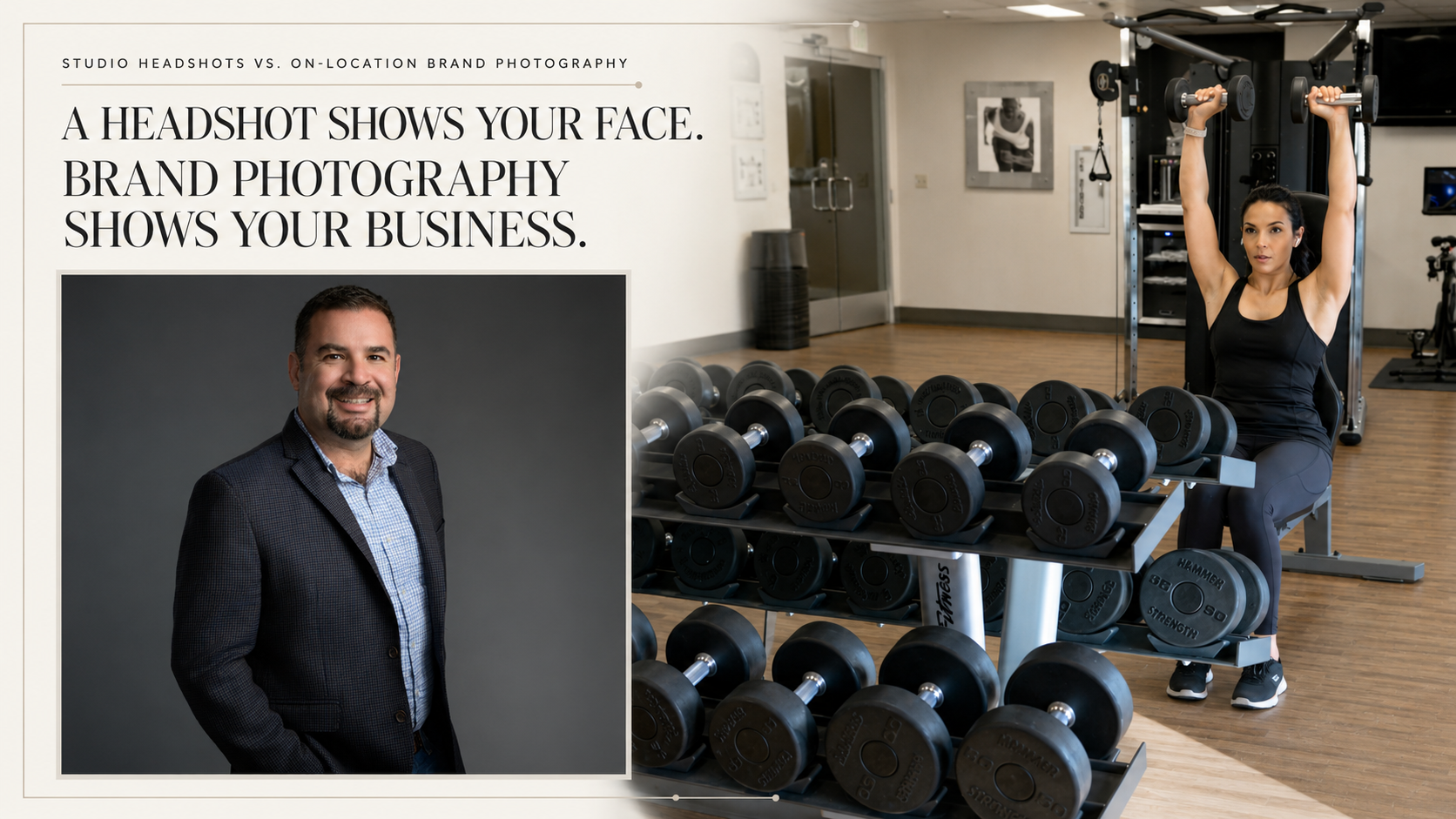
A studio headshot is a controlled portrait of your face, usually against a plain or simple backdrop, made to look professional and consistent. On-location brand photography is a planned set of images that shows the full arc of your business: you doing the work, in the spaces where the work happens, with the variety your website, social, and press kit need.
One answers “what do you look like.” The other answers “what is this business, and why should I trust the person running it.”
That gap matters more than it sounds. A first impression of your website forms in under 50 milliseconds, and 94% of that impression is design and visual, not the words you labored over (Northumbria University research, cited by CXL). The photo carries the verdict before anyone reads a sentence.
When is a studio headshot the right call?
A studio headshot is the right call when you need one clean, current photo of your face and not much else.
If you work inside a company, sit on a leadership page next to other executives, need a LinkedIn photo that matches a corporate standard, or want a quick refresh for a conference bio, a headshot is the correct tool. It is faster, it costs less, and it does what it is built to do.
Corporate teams are the clearest case. Twelve people, same backdrop, same lighting, a directory that looks uniform. A brand session would be the wrong spend there.
The mistake is assuming the studio headshot scales up to a personal brand. It doesn’t. A tighter smile and a nicer backdrop still leaves you with one image of your face and nothing that shows who you serve or how you work.
When does on-location brand photography win?
On-location brand photography wins when you are the brand, and the photos have to do more than sit on an About page.
If your business runs through you, the founder, the expert, the person clients are actually buying, then your visuals have to carry the story a stranger needs before they book. That means images of you with clients, at your desk, teaching, presenting, in your real environment, plus portraits that read at every crop from a website banner to an Instagram square.
Consistency is where the money shows up. A brand presented consistently across every touchpoint can raise revenue by up to 33% (Lucidpress/Marq State of Brand Consistency Report). One headshot cannot make you consistent across a website, a LinkedIn header, a sales page, a lead magnet, and months of posts. A planned library can.
There is also the on-location part specifically. Real environment reads as real expertise. A financial advisor at her actual office, a coach mid-session, a boutique founder in her shop: the setting does silent work that a blank backdrop never will.
Why cheaper and faster is the wrong way to choose
Choosing by price and speed is how women end up paying twice.
The pattern is predictable. A founder books the quick headshots because they are cheap, uses them for a month, then sits down to build a website or plan a launch and finds one usable photo and no verticals, no working shots, no variety. So the booking happens again. The “cheaper” option became the more expensive one.
The better question is not “what costs less.” It is “what does this photo have to do over the next twelve months.” Answer that honestly and the right tool usually names itself.
This is also why AI headshots tempt people and then let them down. In blind tests, recruiters preferred AI headshots 76.5% of the time, but 66% said they would be put off the moment they learned the image was AI-generated (The Studio Pod, Headshot Trends 2026). The shortcut looks fine until the trust it was supposed to build disappears.
How strategy decides which one you need
Strategy is what tells you whether you need a headshot or a brand session, and it happens before any camera comes out.
A health coach called me once wanting two headshots for a new website. On the phone we talked through what brand photography actually is: photos of her with clients, working out, eating well, the full arc of her work. By the strategy meeting, a bigger gap surfaced. The ideal client had never been defined at all. The thinking had always been about what the work was, never about who it was for.
Once we built that ideal client together, every photo decision after it landed differently. The images had a purpose, website, blog, social, plus the tools to use them without drowning. That clarity is the product. The photos are how it shows up.
That is the whole reason I don’t book anyone without a consultation first. If you truly need a corporate headshot, I will tell you so and it will be quick. If you are the face of your brand, we do the strategy first, because that is the only way the photos actually work.
FAQ
Do I need brand photography if I already have a good headshot?
If you are the face of your business, yes. A headshot shows your face. Brand photography shows your work, your clients, and your environment across the many formats your website and content need. A single headshot cannot fill a full marketing calendar, and running your brand on one image is where most founders get stuck.
Are on-location brand photos better than studio for a personal brand?
For a personal brand, usually yes. On-location images place you in your real work environment, which reads as authenticity and expertise a plain backdrop cannot fake. Studio still has a role for clean portraits, and a good session often blends both, but the story a founder needs lives on location.
How do I know if I only need a headshot?
You likely only need a headshot if you work inside a company, need to match a corporate directory, or want one current photo for a bio. If your business runs through you and your photos have to sell, teach, and fill your content, that is a brand session, not a headshot.
Is a brand session worth the higher cost?
For a founder, the higher cost is often the cheaper path over time. A planned library replaces months of scrambling for content and repeat bookings. Consistent brand visuals across every platform can raise revenue by up to 33%, which is hard to reach with one recycled headshot.
The bottom line
A studio headshot is the right tool for a clean, current photo of your face. On-location brand photography is the right tool when you are the brand and the images have to carry the whole story. Choose by the job, not the price tag, and you stop paying twice.
If you are the face of your business and tired of rationing the same three photos, book a consultation at gabyclark.com. We start with strategy, define who your photos are talking to, and build a visual library that actually works.
About the Author: Gaby Clark