H1: How to Choose a Brand Photography Location That Says Something About Your Business
A blank white wall says nothing about your business. Neither does a coffee shop you have never worked in, or a rented studio that could belong to anyone. Those are the backdrops most personal brand photos default to, and buyers feel the emptiness even when they cannot name it.
Your location is not a backdrop. It is information. Before a prospective client reads a word of your copy, the setting behind your face has already told your future client whether you look like the expert they came for.
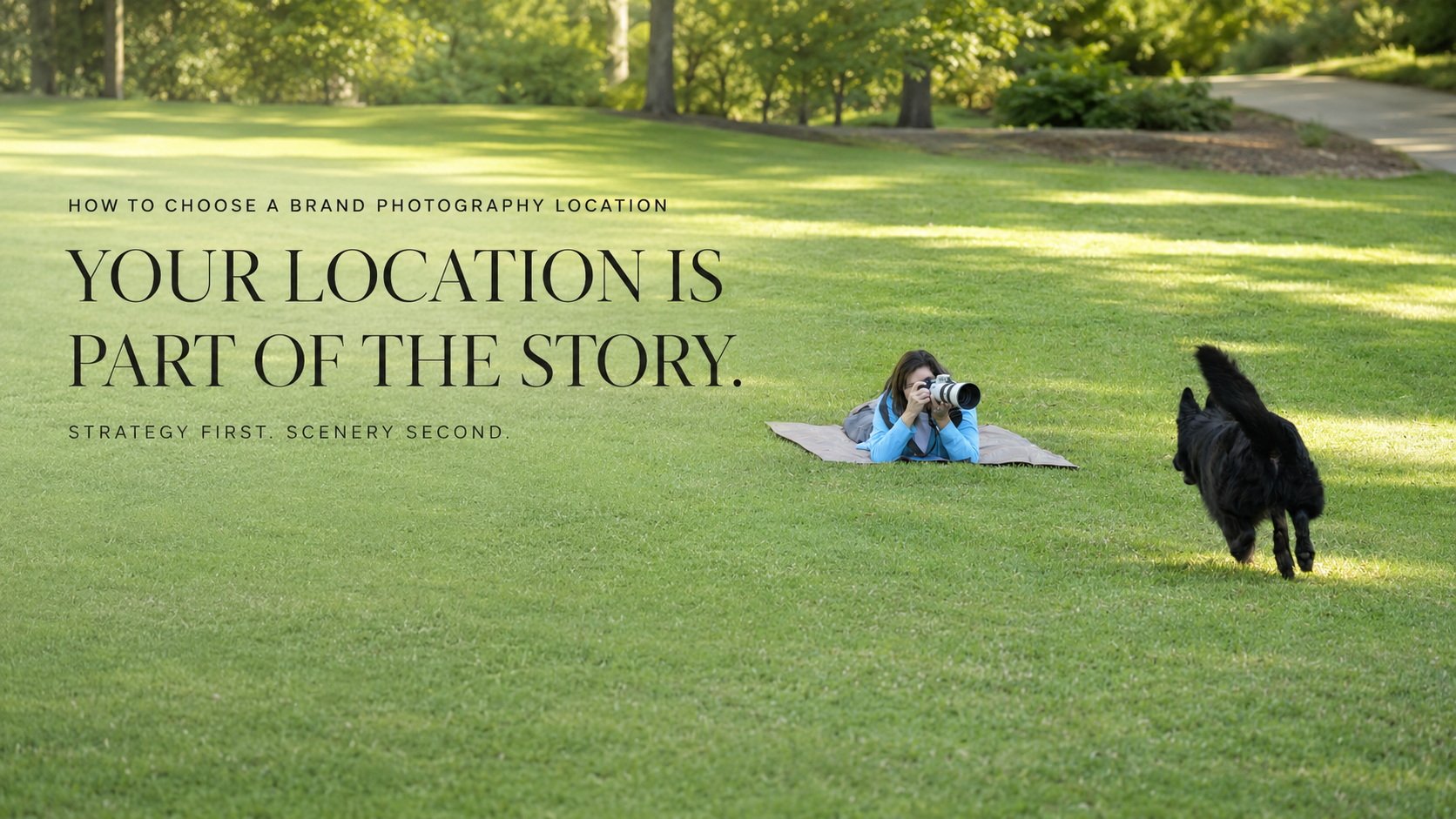
Most women booking a photo session pick a location last, usually the morning of the shoot, usually based on what is pretty or convenient. That is backwards. The location is a strategy decision, and it belongs in the planning long before the camera comes out.
A brand photography location should show where your business actually lives and what it feels like to work with you. Pick spaces that carry meaning for your buyer, your real office, a studio that matches your service, a setting your ideal client recognizes. The right location makes a photo read as true, not staged.
What does a brand photography location actually do?
A brand photography location shows where your business lives and what it feels like to work with you. It gives a buyer context: the kind of work you do, the level you operate at, the world your service belongs to. A good location does the selling your face alone cannot.
Website visitors form a first impression in about 50 milliseconds, and 94% of that impression is design-related, according to research published in Behaviour and Information Technology. Your location is part of that design. It registers before conscious thought, and it decides whether a stranger keeps reading or clicks away.
This is why the coffee-shop default costs you. A generic setting reads as generic. A specific one reads as real, and real is what buyers are looking for.
Why does the right location build trust?
Buyers trust what they can see. When your photos show the actual spaces your business runs in, the message reads as honest instead of staged.
The numbers back this up. In a Marketing Experiments test, real photographs converted nearly 35% higher than stock images, and other tests found real human images lifting conversions by as much as 45%. Transparency drives the same effect: 76% of shoppers now say brand transparency is extremely important to them, up from 69% in 2018.
A location that says something about your business is transparency in visual form. It answers a question your buyer is asking before they book a call: is this person the real thing, or a nice headshot with nothing behind it?
How do you choose a location that says something about your business?
Start with your ideal client, not with what looks good on camera. The right location is the one your buyer recognizes as belonging to their world.
Work through four questions before you pick a single spot.
Where does your work actually happen? A financial advisor works in an office with a view and a conference table. A ceramicist works in a studio covered in clay dust. A consultant works on a laptop in a hundred hotel lobbies. The truest location is often the real one, cleaned up and lit well.
What does your buyer expect the expert they hire to look like? A high-net-worth client expects a certain environment. A first-time mom hiring a postpartum doula expects warmth and a home setting. Match the room to the expectation, not to your personal taste.
What are you selling in the next twelve months? If you are launching a group program, you need photos of you leading a room. If you sell one-to-one, you need intimate settings that feel like a private session. The location should serve the offer, not just the portrait.
What will these photos need to do on your website, your socials, and your press kit? A single location gives you one look. Two or three locations give you a library that carries a full year of content without repeating itself.
What are the three location types every brand session needs?
A complete brand session rarely happens in one place. Plan for three kinds of location so the gallery covers the full arc of your business.
The first is your working environment: the office, studio, or space where the actual work gets done. These images anchor the “this is real” message.
The second is a client-facing setting: you in conversation, mid-meeting, doing the thing you get paid to do. These show the experience of hiring you, not just your face.
The third is a lifestyle or brand-world setting: a location that carries the feeling of your brand even if no work happens there. A bookshop for a writing coach, a garden for a wellness practitioner, a clean modern cafe for a brand strategist. These give your content warmth and range.
A health coach who once called wanting two headshots is a clear example. Her plan grew into photos of her with clients, working out, and preparing food, because those locations told the whole story of her work. By the end, every image had a place to live: website, blog, social. That is what three location types buys you.
What should you avoid when picking a location?
Avoid locations that fight your face for attention. Busy patterns, harsh light, and cluttered backgrounds pull the eye away from you and confuse the message.
Avoid locations that lie. A rented mansion for a business that operates from a home office reads as false the moment a client meets you in person. The gap between the photo and the reality erodes the trust the photo was supposed to build.
Avoid picking a location before you have defined who the photos are talking to. A beautiful setting aimed at the wrong buyer is a wasted shoot. The location decision comes after the strategy, never before it.
How does location fit into a real brand strategy?
Location is a SHINE decision that only works when the ALIGN work is done first. Inside the Align. Shine. Scale. Method, the strategy session defines your ideal client and your brand voice before a single location gets chosen. Once you know exactly who you are talking to, the location almost picks itself.
That is the piece most photographers skip. They ask what looks nice. The better question is what your buyer needs to see to believe you are the expert they have been searching for. A location chosen against a clear strategy stops being decoration and starts being a sales tool.
Frequently asked questions
How many locations do I need for a brand photography session?
Plan for two to three locations for a full brand session. One working environment, one client-facing setting, and one lifestyle setting gives you enough range to fill a website, a press kit, and a year of social content without every image looking the same. A quick headshot needs only one.
Can I use my home or office for brand photos?
Yes, and often it is the best choice. Your real working space reads as authentic, which buyers trust more than a rented studio. The space needs good light and a clean, intentional background. A real office, styled and lit well, beats a generic location that means nothing to your buyer.
Should the location match my industry?
The location should match what your ideal client expects the expert they hire to look like. That usually connects to your industry, but the real test is your buyer’s expectation, not a rule about your field. Match the room to the person you are trying to reach.
When should I choose my location, before or after planning the shoot?
Choose your location after you have defined your ideal client and brand voice, never before. The strategy tells you who the photos are talking to, and the right location follows from that. Picking a pretty spot first and building strategy around it is how women end up with galleries they never use.
Your location is a decision, not a default
The best brand photos do not happen in the prettiest room. They happen in the room that tells your buyer the truth about who you are and what it is like to work with you.
That decision starts with strategy, not scenery. If you are ready for brand photos that actually work, book a consultation at gabyclark.com and we will map the location, the plan, and the buyer they are meant to reach, together.
About the Author: Gaby Clark